
By Phyllis Simone
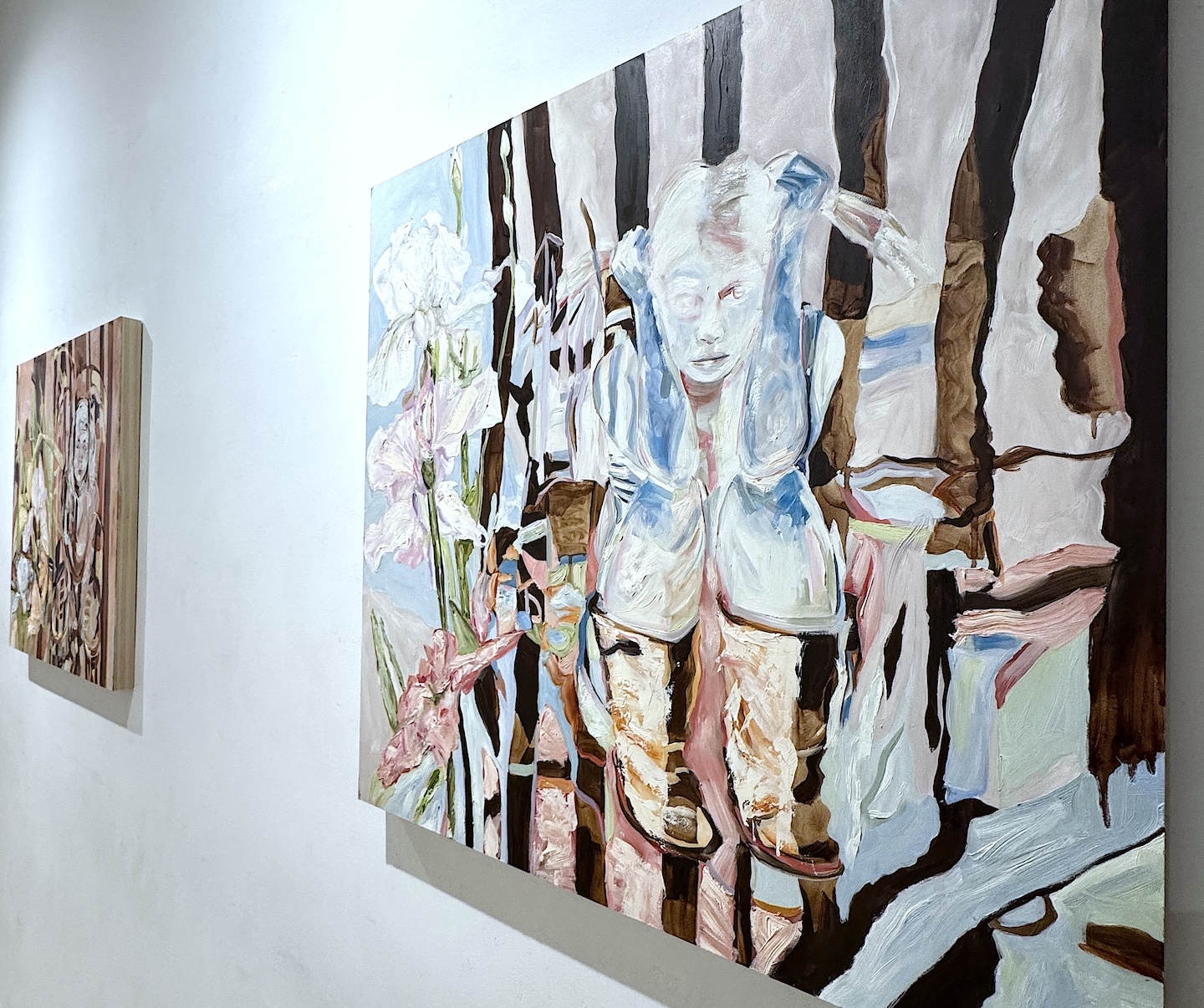
Deborah Barr’s imagery invites a renewed examination of the human body as it exists under vulnerability and pressure in the age of social media. Her work operates on multiple levels, encouraging both presence in the moment and reflection on impermanence. While each image stands independently, its meaning deepens when viewed as part of a larger suite.
Barr’s visual language balances totemic wholeness with deliberate fragmentation, producing imagery that is both striking and unsettling. Her near-confessional representations recall Viennese artists such as Christian Schad and Egon Schiele, whose work demands a dual awareness—intense introspection tempered by emotional distance. This tension gives Barr’s work its sharp intensity.
Her subjects can be read as contemporary embodiments of Eros and Thanatos, or as ritualistic acts of deposition, engaging directly with ideals of beauty shaped by social media. Barr’s recent work reflects Generation Z’s fixation on perfection and digital identity, shaped by AI, filters, and photographic manipulation. These tools destabilize reality, creating idealized yet false icons through altered features, skin tones, and erased imperfections.
By presenting luminous surfaces alongside photographic inversions, Barr allows figures to dissolve into fields of color and reversed light, mirroring the psychological effects of technological acceleration and information overload. The resulting defamiliarization is counterbalanced by intimacy and the everyday. Through synecdoche, fragments stand in for the whole, reinforcing the tension between the natural and the manipulated, presence and absence, immanence and transcendence.
Phyllis Simone is na art writer leaving and working in Manhattan.