
“Less talk and more ART…”
Paul Zimmerman in conversation with Yasmine Shimi
How did you get interested in art?
Yasmine Shimi: I went to art school ( Bham city university – faculty of art & design ) aged 19 and had my first life drawing class in the 3rd week and I was hooked . It was a four year art and design course at and I owe my happiness to that four years I learned so much and was totally free to choose what I wanted to do and the history of art and architecture and French movie directors and theatre design , it was just a massive bundle of art and culture. I never wanted to do anything else.
Paul Zimmerman: What is the most challenging aspect of your work?
YS: I usually only paint when I am totally overwhelmed by my subject I am rarely under time pressure my work has a natural flow, I don’t paint when I am not bursting with enthusiasm I work with vigour and energy. Often several ideas spark from one piece. My challenge was to learn the drawing and painting tools on my first iPad and use my index finger accurately, I prefer it to apple pen, this was soon after David Hockney’s first IPad painting exhibition at Royal Academy in London on 2012. I only paint when I have several ideas then the work just flows, no battles just enjoying the process .
PZ: What is your artistic process? How do you create your paintings?
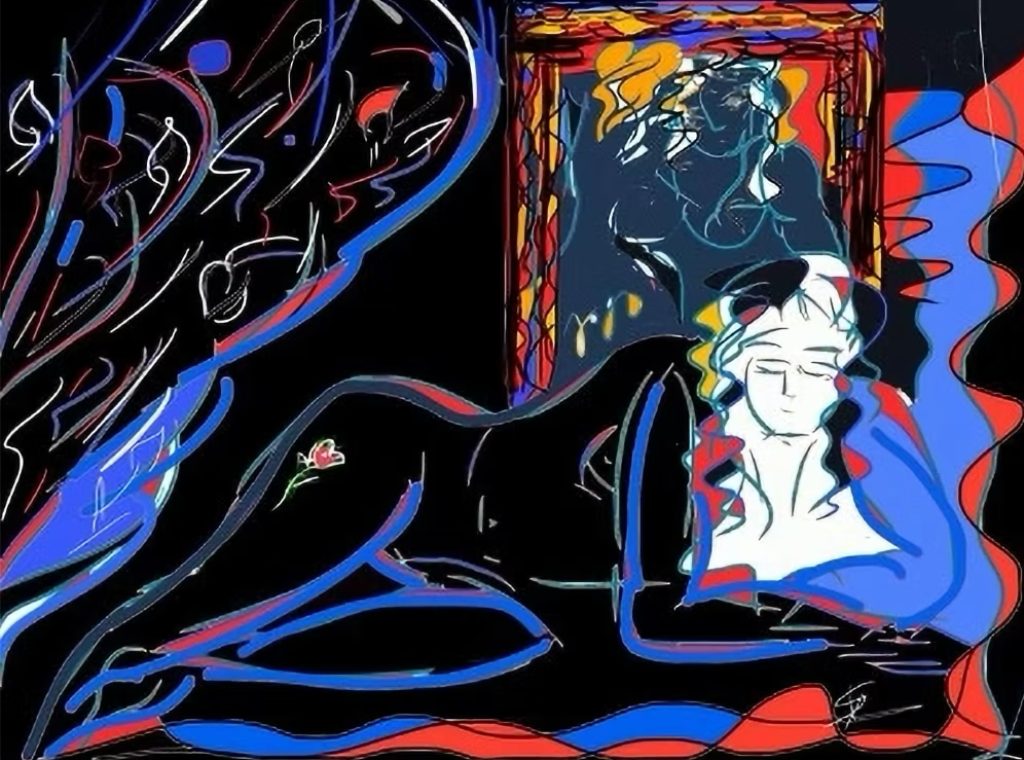
YS: My ideas often come from life drawing session or current affair or an extraordinary sunset or dusk, my studio in south of France faces south and from 350 meter above sea level i have uninterrupted clear sky and cloud and seascapes, hills and trees the light is so beautiful which is why so many artists come here to paint. I enjoy playing with the background, in the ballet boy I painted a theatrical landscape behind the figure, and in the clouds too I have given a surreal background to the figure of a man rising high , reaching out to the clouds and beyond, there is a lot to read into the this series, our lives are now all in the “Cloud “…. In one with nature clouds and the sea appear in harmony with the reclining female figure, we are one with nature. The paintings have a way of falling naturally into place and showing what I am thinking and imagining.
Compositions form themselves mixing figural into the landscape the connection is natural and not forced.
PZ: Do you have any particular goal in mind when you start a new piece?
YS: I usually start very free, flowing lines the composition must include the story around the figure, the verticals and horizontals are important to me allowing the composition to develop.
In Scaffolding, i fused the energy of the flower market with bold architectural verticals to create a new visual rhythm. I brought in the Lily my favorite flower as a nod to symbolism of purity I as in Botticelli’s Birth of Spring. That sense of purity stands in deliberate contrast to Soho where the work was originally painted – a place charged with vitality grit and excess.
PZ: How do you know when the painting is finished?
YS: One is always asking is it done? So much depends on the paintings some times you know straight away you’re happy and you step away , other times takes weeks or months you keep going back.
With digital painting it’s easier to move on and do a different version, that’s one of the reasons I like the iPad paintings I can play with them for ever add and take away and it will still look fresh.
PZ: Has your practice changed over time?
YS: Yes and No. When I lived in Nottinghill there was so much graffiti, the buildings looked so different all painted different colours so buzzy so many different smells of food and fruit and flowers, then a two week project in Soho had a completely different vibes.
Soho was full of scaffolding and the tiny old video shops and tattoo parlours were being replaced with trendy cafes and Restaurants, Soho was a very rich experience and I did a massive project on it.
Almost 6 series under one umbrella like Soho Project with a subdirectory of model, scaffolding, doors and the graffiti, it took years.
PZ: Which artists are you most influenced by?
YS: My influences are pretty diverse, David Hockney was always present his work grew to such a great extent, I always loved the Fauve movement ,Dali was always a beacon of refined technicality and imagination. Howard Hodgekins abstraction of form i love his colour use and simplicity specially of his travels to India. Picasso, I went to his exhibition at Royal Academy in london it was called je suits le cahier, the sketch books of Picasso 1986. I was amazed of how Picasso used pencil, I bought the frame poster of the exhibition which hangs to this day in our hallway extraordinary pencil work I look at it everyday it’s 1meter by 70cm.
PZ: How would you define yourself as an artist?
YS: My art is a direct mirror of the environments that shape me – urban or rural , raw or refined .Every line or brushstroke is a narrative drawn from my lived experiences , transforming personal stories into universal reflections.
I guess getting my first iPad and learning the tools was quite a challenge this was soon after David Hockneys IPad exhibition at Royal Academy in london in 2012.
PZ: What are you working on now?
YS: Like many I have been much affected by the war in Ukrainian and have been doing some paintings resembling the frustration of a leader who is doing all he can to save his nation from a total destruction and being wiped off the map. I painted two sets of paintings but I feel I need to do a bit more.
PZ: What is the main message of your work?
YS: My message is that we all need art to be part of our daily life, we need art to be an integral part of our society. I think The Arts connect people on all levels wethers it’s a performing arts or visual arts we need less talk and more ART. The arts reminds us of our essence which Is love and kindness and compassion.