
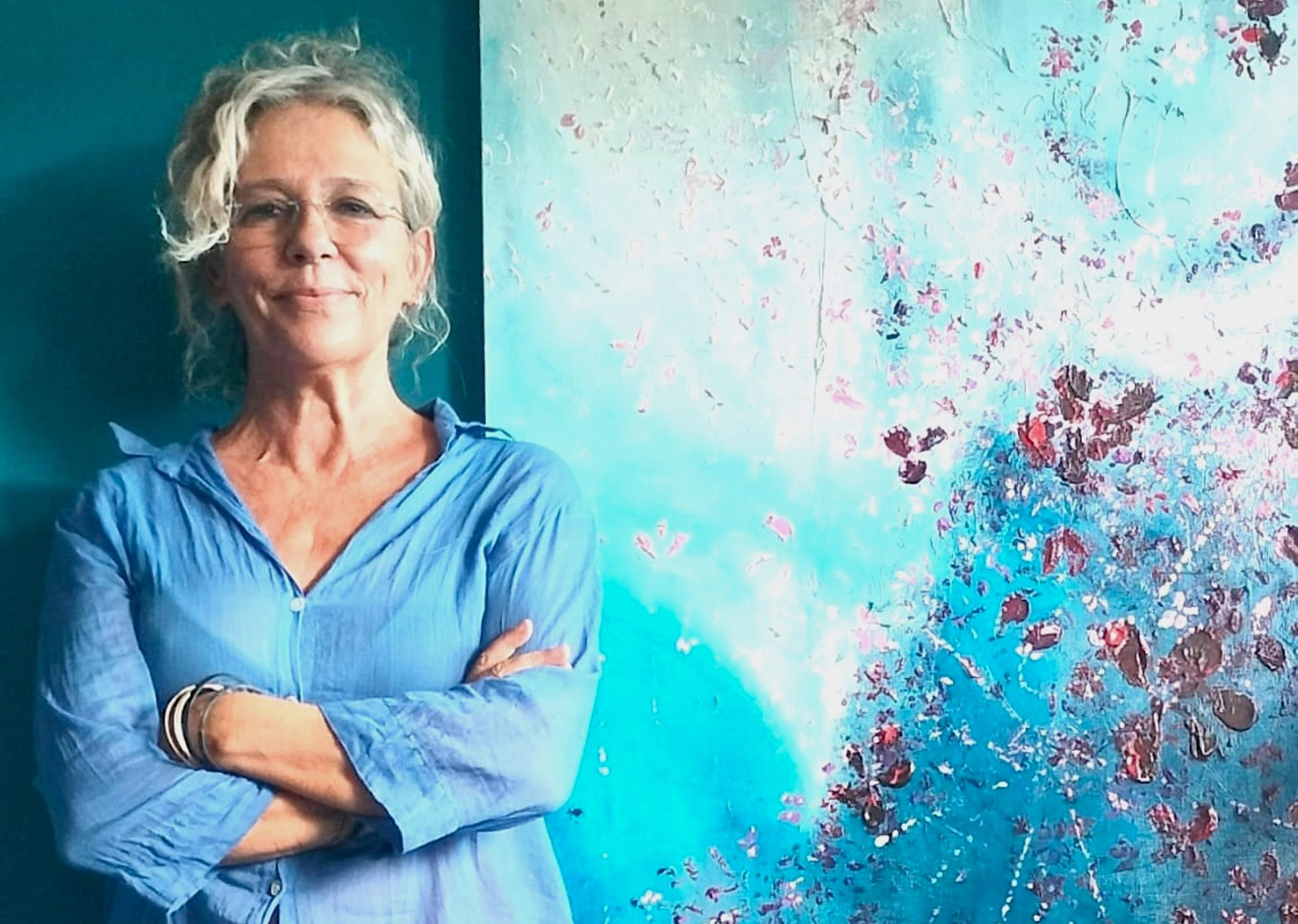
“My gardens are places of rebirth…”
Paul Zimmerman in conversation with Teresa Bellini
Paul Zimmerman: Your latest series is inspired by Chinese traditional art. Where does this interest come from?
Teresa Bellini: My interest in traditional Chinese culture stems from a connection that is both intellectual and deeply lived. I graduated in Oriental Languages and spent three years in China in the late 80s and early 90s. It was not just a linguistic and work-related program, but a full immersion into a different world and way of perceiving time, space, landscape, and the relationship between human beings and nature.
This series, therefore, does not arise from a decorative reference to Chinese art, but from the theme of the Five Elements as dynamic and transformative forces. This is where the connection with my current research emerges: from transformation, balance, the relationship between nature, gesture, and matter, alongside a more personal dimension made of memories and residual images from my travels that, over time, become an inner geography.
PZ: How do you translate this tradition into a contemporary visual language?
TB: Each painting is inspired by one of the Elements, and the Chinese character present in it represents the Element that is the subject of the work. I am not interested in referencing tradition in an illustrative or decorative way; rather, I seek to absorb its deeper principles and let them pass through my contemporary sensibility.
I re-elaborate the traditional characteristics of each Element by translating them into color, gesture, matter, composition, atmosphere, rhythm, and equilibrium—all of which I feel deeply vibrating as dynamic forces when I paint. Water—my Element, for example—becomes depth, blue, fluidity, the feminine, memory. The gardens I paint are not realistic locations; they are inner spaces traversed by memories, movements, fragments of journeys, representing a state of being.
PZ: Nature is a recurrent subject in your work. What specific memory served as the primary starting point for this?
TB: Not a single specific memory, but my necessity to return to nature as a place of primordiality, simplicity, and health. These are emotional, fertile, open spaces. Evoking nature does not mean, for me, representing something external; it means seeking an essential condition of being. And perhaps a way to draw closer to something primordial—before noise, before excess. My gardens are places of rebirth, re-flowering, and transformation.
PZ: How does your initial concept change as you begin working with the physical materials?
TB: In the beginning, there is a constellation of intuitions: a color, a memory, a rhythmic structure, a certain atmosphere. But when I actually begin working, the painting demands something else. Matter introduces resistance, the unexpected, deviation—and for me, this is a fundamental part of the process, enriched by stratifications, veils, scratches, and superimpositions.
I try to listen to what happens on the surface and allow the work to find its own inner necessity. It is a continuous dialogue between intention and surprise. At that turning point, the work ceases to be an idea to be executed and begins to become an autonomous presence.
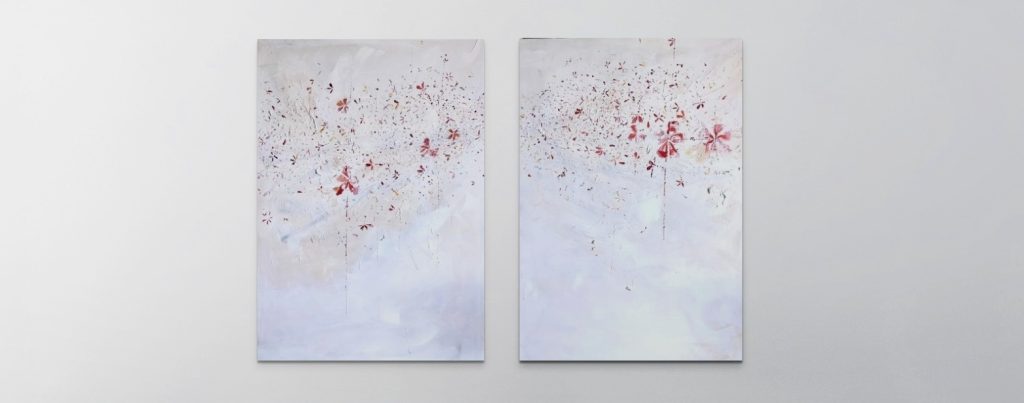
PZ: What does your chosen medium of acrylic on canvas allow you to express that no other art form can?
TB: Acrylic on canvas allows me a combination that feels very close to my working method: rapidity and stratification, decision and transparency, gesture and construction, material grounds, the possibility of creating infinite colors, and the use of my hands and different tools. I can intervene repeatedly and immediately, proceeding with glazes or with gestural interventions.
The rapid drying time of acrylic suits my way of painting better.
PZ: How has your personal definition of beauty or meaning shifted since you first started creating?
TB: Totally. Since I began creating, my gaze on the world has changed, and I have become very demanding in terms of beauty and harmony in the places and situations I open myself to.
At the beginning, I think I sought beauty as visible harmony—as something that immediately imposed itself on the gaze. Over time, however, I have become increasingly interested in a less declared beauty, more essential, that arises from an inner rightness rather than from effect.
My works seek to open a space of perception, one that contains an emotional truth, even if ambiguous, even if not entirely translatable.
PZ: How do you address your inner critic when you are dealing with a challenging project?
TB: It is part of the process; I listen to it, I test it with initial dissonant drafts that I then refine until the work satisfies us both. My inner critic accompanies me in the process to help me feel whether the painting is alive, whether it has a necessity, whether it is leading me somewhere I do not yet fully know. Sometimes it exasperates me and leaves me exhausted for days after completing a work.
PZ: Do you have a specific routine to enter your creative zone?
TB: The early hours of the morning are the most inspiring and productive time for me, so I always spend them in the studio. There, I create a place of silence and concentration. Then there is music, which is fundamental for me and for my gardens. My flowers bloom rhythmically, not logically. The garden is sound, and the music becomes color that breathes. I avoid spending the entire day in the studio because there are other activities I prefer and consider preparatory to creation, such as physical movement, spending time outdoor, cultural events as exhibitions, cinema, concerts and reading.
PZ: What is a part of your work that some viewers may miss?
TB: My gardens are born from an inner necessity to give a harmonious sense to pain. Often, the intuition arises from a negative feeling or memory, but then, little by little, I feel this positive will emerge to sublimate into beauty. It is a positive process that takes place accompanied by music. Every note is a seed, every pause an invisible root.
These gardens do not speak only of nature, but also of memory, pain, traversal, nostalgia, rebirths, and re-flowering. They are inner landscapes. And the flowers are never just flowers: they are also signs, beats, musical notes, points of emergence of time within the image.
PZ: If your entire body of work were a single story, what central question is it trying to answer?
TB: The question is: how can we rediscover a harmonious and essential relationship with life without losing the complexity and dramatic quality of lived experience?
In the end, my work returns again and again to that: the attempt to recompose fragments—journeys, memories, traumas, visions, pain, nostalgia, nature—into a form that does not simplify reality but renders it habitable once more.
I am interested in the idea that painting can be a place of reconnection: with something primordial, vital, silently true, and deeply my own.